
The Federation of European Societies of Plant Biology (FESPB) organizes a large international Plant Biology Congress every two years.
As the sponsors for the FESPB Young Plant Scientist Award 2025, we are proud to present the winner, Marta Nunes da Silva
Here is an interview we conducted with her earlier
Can you tell us briefly about the research that earned you this recognition?
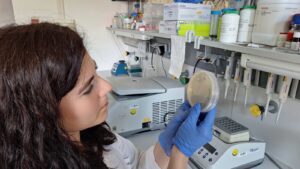
At its core, my research asks a simple question: how can we help plants defend themselves. I combine molecular biology, plant physiology, biochemical profiling and omics-based approaches to understand how crops respond when they face stress, particularly from pathogens. First, I look for natural differences in how varieties cope with stress, and then I zoom in on the physiological traits, metabolites, and genes that make some plants more tolerant. A major focus of my work has been quarantine pathogens that can devastate entire sectors, particularly Pseudomonas syringae pv. actinidiae, which causes bacterial canker in kiwifruit, and the pinewood nematode Bursaphelenchus xylophilus, responsible for the pine wilt disease. By clarifying how these pathogens interact with their hosts and which defense pathways can be reinforced, my work aims to reduce reliance on synthetic pesticides and to support healthier, more resilient agroforestry ecosystem.
What inspired you to focus on this particular area of plant physiology?
When I first started studying Biology, I quickly realised that plants are central to our existence. We rely on them for food, shelter, clothes and energy, yet every year we lose close to 40% of global crop production to pests and diseases. That gap between how essential plants are and how vulnerable they can be really struck me. As microbiology was always one of my favourite subjects, I began looking for research opportunities at the interface between plant science and microbiology. That is how I discovered phytopathology, the study of plant diseases. I was fascinated by the invisible battle between plants and their pathogens and by the idea that understanding this dialogue at the physiological and molecular levels could help us design more resilient cropping systems. From that moment on, I was hooked.
How does your work advance our understanding of plant function, adaptation, or resilience?
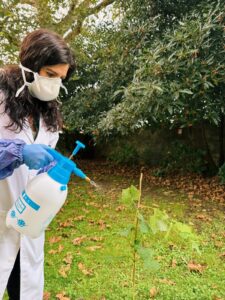
My work tries to open the black box of “resistance” and show which concrete traits make some plants more resilient than others. In pines facing the pinewood nematode, we linked natural variation in resistance to very tangible features, such as resin canal anatomy and the production of defensive phenolics. We then showed that these traits are not static, they can be strengthened through priming with methyl jasmonate or by using microbial biofertilizers that helps trees fight the disease. In parallel, we compare how different kiwifruit species cope with bacterial canker, and uncovered that the kiwiberry recognises Pseudomonas syringae pv. actinidiae earlier and mounts a faster antioxidant and structural defence response than the green kiwifruit. By combining this with work on nutrition and elicitors, we showed that plant resilience emerges from the interaction between genotype, physiology and management. Overall, my work contributes to advance our understanding of plant function and adaptation by pinpointing which ecophysiological traits, genomic signatures and management regimes favour resilience.
 Could you share a key challenge you faced in your project and how you overcame it, if any?
I believe that research is rarely defined by one big challenge, but rather by a constant sequence of them. Scientists are continually under pressure to publish, to secure funding, to keep projects and teams running. Those are very real constraints that I feel are shared by most scientists. A more personal and ongoing challenge for me is making sure that my findings do not stay trapped in papers, but actually reach the people who need them most, such as farmers, advisors and fellow plant scientists. It is one thing to show that a treatment or a genotype works in controlled conditions, and quite another to translate that into field-ready tools that are affordable, practical and trusted. To tackle this, I have tried to work closely with growers and practitioners from the start, co-designing trials, listening to their constraints and sharing results in accessible formats, not only through journals but also field days, talks and training sessions. It is still a work in progress, but bridging that gap between discovery and practice is the challenge that motivates me the most.
What do you see as the next big question or challenge in your field?
I see climate change as the defining challenge for crop protection. Erratic weather, heatwaves, droughts and unseasonal frosts not only weaken plants’ own defences, they also shift where pathogens can thrive and how aggressive they are. This means that the resilient varieties and disease management tools we rely on today may not work under tomorrow’s conditions. So, the big question for me is how to design crops and cropping systems that can stay one step ahead of this moving target. This will require bringing together genetics, physiology, microbiomes and agronomy, and using advanced modelling to predict which combinations are more likely to work under future climates. Equally important, we need to test these solutions in real fields, in partnership with farmers, so that new tools are not only biologically effective, but also robust, practical, and affordable.
How do you see emerging technologies (e.g., omics integration, imaging, AI) shaping your field in the coming years?
The decreasing cost of omics is finally allowing these tools to move from specialised case studies to routine use in crop improvement, which I find very encouraging. We can now link gene expression, metabolites, microbiomes and phenotypes at scale, instead of looking at each layer in isolation. In parallel, advances in imaging are helping us “see” plant health and stress in a non destructive way, from individual leaves to whole fields. High resolution imaging and hyperspectral and thermal sensors can reveal early signs of infection, nutrient imbalance or water stress before symptoms are visible, which opens the door to monitoring plant responses in real time and to precision farming.
I am especially excited about how artificial intelligence can integrate all these data streams and uncover patterns that the human eye might miss. Rather than replacing scientists, I see AI as a way to generate better hypotheses, design smarter experiments and build more robust predictive models of plant resilience. In believe that coupling these emerging technologies with careful experimental design, strong ecophysiological approaches and close collaboration with farmers will be essential to turn complex data into tangible gains for crop protection and sustainable agriculture.
 What first sparked your interest in plant science?
Plants make up most of what we eat, close to 80% of the human diet, and yet they are often invisible to us in everyday life. When I started studying Biology, I was struck by this contrast. Plants quietly sustain our food, our landscapes and even our climate, but they cannot move away when conditions change or when pathogens attack. They have to solve every problem where they stand. That idea, that a rooted organism can be so dynamic and inventive in the way it grows, senses its environment and defends itself, really captured my curiosity. Very quickly I realised that understanding plant biology is not only intellectually fascinating, it is also essential if we want to feed people sustainably and protect ecosystems. That is what first drew me into plant science and what still keeps me there.
Who has influenced your scientific journey the most — a mentor, a paper, or a key idea?
I have been very fortunate in my career to work with inspiring mentors and collaborators, people who showed me that rigorous science can go hand in hand with curiosity, fairness and a sense of service. They taught me to value careful experimental work, to be honest about uncertainty and to see collaboration rather than competition as the default, and they ultimately shaped my integrity, my values and the way I see science. But if I had to choose one main driver of my scientific journey, it would be a question rather than a person: how can we feed a growing global population in ecosystems that are already depleted and under stress? This question is always at the back of my mind when I decide which projects to pursue. It pushes me to work on solutions that are not only scientifically interesting, but also realistic for farmers, compatible with local contexts and supportive of long term ecosystem health.
What advice would you give to other young researchers hoping to make their mark in plant physiology?
I would say three things: stay curious, be resilient and keep sight of the social purpose of your work. Curiosity is what keeps research enjoyable on the days when experiments fail. Ask questions that genuinely interest you, learn new methods and do not be afraid to cross disciplines, some of the most exciting insights in plant physiology come from those interfaces. Resilience is equally important: papers get rejected, grants do not get funded and experiments often refuse to behave. Try to see feedback as a tool for improvement rather than a verdict, surround yourself with supportive colleagues and remember that progress in science is usually incremental, not linear. Finally, keep in mind the people who may benefit from your work. Whether you study signalling pathways, crop nutrition or spectral imaging, think about how your findings could one day help farmers, breeders or conservation efforts. Let that sense of social benefit guide your choices, it makes the tough moments much easier to navigate.
How do you balance curiosity-driven research with the pressure to produce results or publish?
For me, curiosity and pressure are not opposites, they just operate on different timescales. Curiosity drives the questions I choose to work on, the systems I study and the methods I learn, while the pressure to publish reminds me that I need to turn those questions into concrete, tangible outcomes that can move plant sciences forward in a reasonable timeframe. In practice, I try to keep a balance between safer, publishable work and more exploratory ideas. Some projects are designed to deliver solid results that support my team and funding, but I always keep space for one or two bolder questions where the outcome is less predictable. I often involve students and young scientists in these exploratory projects, so that even if the work does not immediately translate into a publication, it still contributes to their training and helps foster their scientific curiosity.
What does receiving the Young Scientist Award mean to you personally and professionally?
Receiving the Young Scientist Award is, above all, a reassurance that the questions I have been working on matter, and that the long hours in the lab, greenhouse and in front of a computer are contributing something of value to the community. It is both humbling and motivating. Professionally, it offers a wonderful opportunity to make my work more visible, to connect with colleagues who face similar challenges and to open doors for new collaborations. I hope it will help more people become familiar with my work, not only in terms of scientific recognition, but also in terms of uptake and application. It also feels important to me that this award highlights the quality of plant science being done at my institution (the Centre for Biotechnology and Fine Chemistry) and in Portugal more broadly. I see it as a collective recognition, shared with my mentors, colleagues and students, and as an encouragement to keep pushing for rigorous, socially relevant research in plant physiology.
Once again, congratulations and best of luck in your scientific journey ahead.